Ships from our U.S. warehouse · $4.99 flat shipping · Free on orders of $49.99+ with code FREESHIP at checkout · Shipping & returns
Both are ROL0 — IPC J-STD-004B classifies flux by chemical activity, and it says nothing about tack. So the two grades sit in the same classification and do genuinely different work. Pick by whether something has to stay put while it heats.
| Standard — No-Clean Soldering Flux | Tacky — No-Clean Tacky Flux | |
|---|---|---|
| SKU | TFX-RO-10CC | TFX-RT-10CC |
| Classification | ROL0 (IPC J-STD-004B) | ROL0 (IPC J-STD-004B) |
| Solids content | 68–72% (typical) | 72–76% (IPC 2.3.34) |
| Tack force | Not specified | Evaluated by IPC-TM-650 2.4.44 (adapted) |
| Holds a part through ramp-up | No — not designed for it | Yes — that is the point |
| Best for | Touch-up, wire tinning, desoldering & wick clean-up, chip/component rework, general board repair | BGA / QFN / LGA reballing, holding components through reflow, stencil printing, pin transfer, fine-pitch rework |
| Price | $9.99 | $13.99 |
| Status | Available | Available |
If you are tinning wire, cleaning up a bridge, or reflowing a part that is already held by its own leads, the standard grade is the right one and it costs less. Reach for the tacky grade when gravity, airflow or a bumped board would otherwise move the part before the solder melts.
Every use below shares one requirement: something must not move between placement and reflow.
Holds the ball array to the stencil and the package to the board through the ramp. This is the job that tack exists for — a standard flux paste lets balls roll.
Tacks chips, connectors and shields in position on a hot plate or in a reflow oven, so a tilted board or hot-air blast does not shift them before the joint forms.
Higher solids and thixotropic body give clean release from apertures and a controlled dot on transfer pins, without slumping between print and placement.
Stays where it is placed on tight pitch instead of wicking across the pad field, so the flux is under the joint you are working on and not the three beside it.
Replacing one missing or damaged ball on a BGA, or setting a solder preform on a pad: a dab of flux under it keeps that ball or preform in place until it wets, with no stencil needed.
Spread a thin, even film, dip the ball side of a package-on-package top part or CSP, then place it. The flux it picks up stays on the balls and holds the part down as you set it.
Every brand in this category prints the word. Almost none publishes a number behind it — because IPC J-STD-004B, the standard that governs flux, has no tack requirement at all. Tack is a solder-paste property, defined in the J-STD-005A family. We evaluate tack with that method anyway, and state the method number beside every figure we publish.
A probe is pressed into the deposit and withdrawn; the peak force required is the tack, reported in gf. The method is written for solder paste, so for a flux-only product it is applied as an adapted method — which we state alongside the value rather than quietly omit.
The physical origin of tack. A liquid flux runs about 4% solids; a paste like ours runs near 70%. The tacky grade goes higher still — that is the lever behind the tack.
Reported with the spindle and speed, plus the low-speed / high-speed ratio. This is what decides whether the paste pushes cleanly out of a syringe yet refuses to slump once it is on the board.
Halide content by ion chromatography, copper mirror, copper corrosion and SIR — the methods that define ROL0 residue reliability. Higher tack must not cost you residue reliability, so this grade is specified to the same methods as the standard grade.
Typical values are not specifications. Lot-specific data available on request.
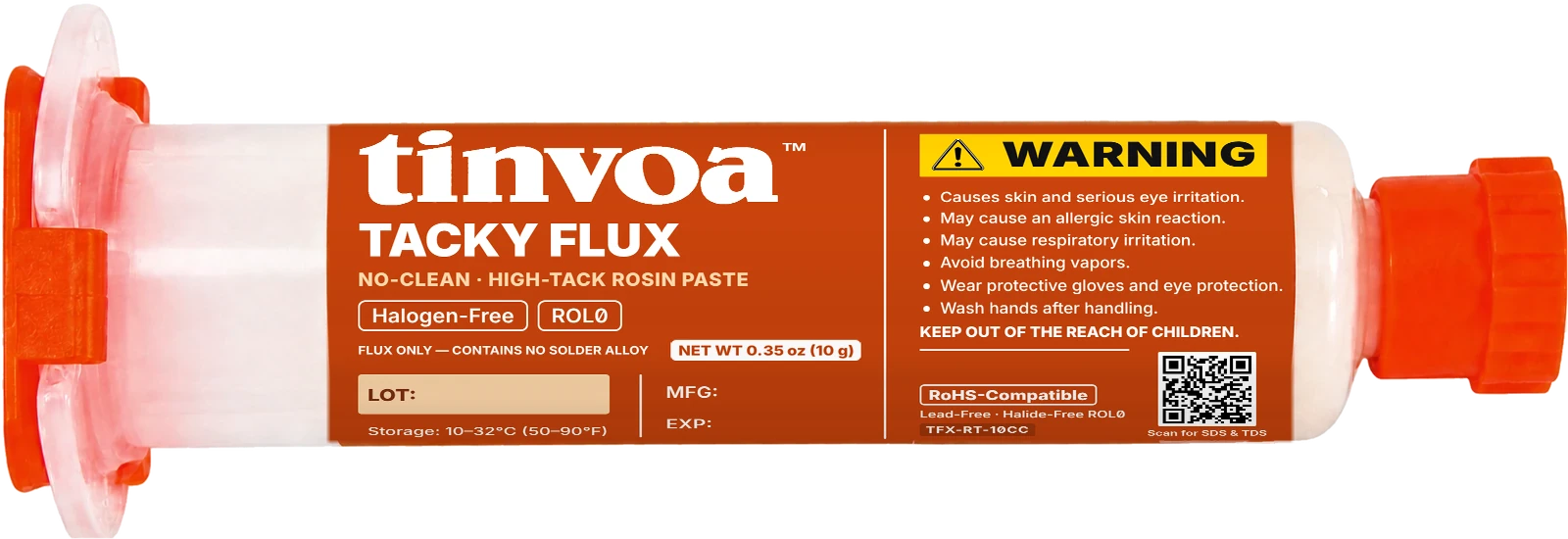
| Product name | No-Clean Tacky Flux |
| SKU | TFX-RT-10CC |
| Flux type | No Clean |
| Flux classification | ROL0 (IPC J-STD-004B) |
| Flux base | Rosin / modified resin, high solids |
| Activator system | Low activity, halogen-free organic activators |
| Appearance | Amber, translucent, non-slumping tacky paste |
| Solids content | 72–76% by weight (IPC 2.3.34) |
| Tack force | Evaluated using IPC-TM-650 2.4.44, applied as an adapted method (2.4.44 is written for solder paste). Data available on request. |
| Halide content | Halide-free — <0.05% by weight in flux solids (IPC-TM-650 2.3.28.1, ion chromatography) — ROL0 per IPC J-STD-004B. |
| Halogen content | Halogen-free — no intentionally added halogens. |
| Reflow profile | Ramp 1–2°C/s · dwell 1–2 min at 135–160°C (SAC, Sn-Pb) or 100–130°C (Sn42/Bi58) · peak and TAL per your alloy’s TDS |
| Application methods | Dot dispensing · syringe · stencil printing · pin transfer · BGA reballing · rework soldering |
| Net content | NET WT 0.35 oz (10 g) · 10 cc syringe |
| Storage | 10–32°C (50–90°F), no refrigeration required |
| Shelf life | 12 months unopened from date of manufacture / 6 months after opening. |
A flux has no melting point, so there is no single reflow curve to publish. For SAC and tin-lead alloys, dwell at 135–160°C; Sn42/Bi58, often used for reballing, melts at 138°C, so soak it at 100–130°C instead. The peak is set by the solder you pair it with. Tack holds the part in place across that whole ramp.
Peaks are typical references — follow your alloy’s TDS and validate on your own thermal-mass test board. Full flux parameters in the TDS below ↓.
High-tack rosin-based ROL0 no-clean flux paste. Classified under OSHA HazCom 2024 (GHS). Refer to the product SDS for the complete, authoritative classification.
Keep out of the reach of children. California Proposition 65: rosin (colophony) is not a listed chemical; no warning is required. Safety Data Sheet available on request ↓
Data behind the spec sheet is available on request.
Step-by-step guide for BGA reballing, holding parts through reflow, and fine-pitch rework.
GHS classification, handling, storage, disposal — provided on request.
Lot-traceable statement of conformance to this product's specification. Issued per lot with wholesale orders.
Tack, not activity. Both are ROL0 rosin fluxes, but tacky flux has higher solids (72–76% vs 68–72%) and a non-slumping body, so it holds BGAs, QFNs and chips in place through the reflow ramp. For general rework, the standard No-Clean Soldering Flux is enough.
Yes. It is made for BGA reballing, dot dispensing, syringe application, stencil printing, pin transfer and rework. Dwell 1–2 minutes at 135–160°C for SAC and tin-lead, or 100–130°C for Sn42/Bi58, and let the solder alloy set the peak.
At room temperature, 10–32°C (50–90°F); no refrigeration is needed. Shelf life is 12 months unopened from the date of manufacture and 6 months after opening.
Room-temperature storage, a 12-month shelf life, and a tack force defined by an IPC method, not an adjective. Ships from our U.S. warehouse — $4.99 flat, free on orders of $49.99+ with code FREESHIP.