Home/Products/No-Clean Soldering Flux
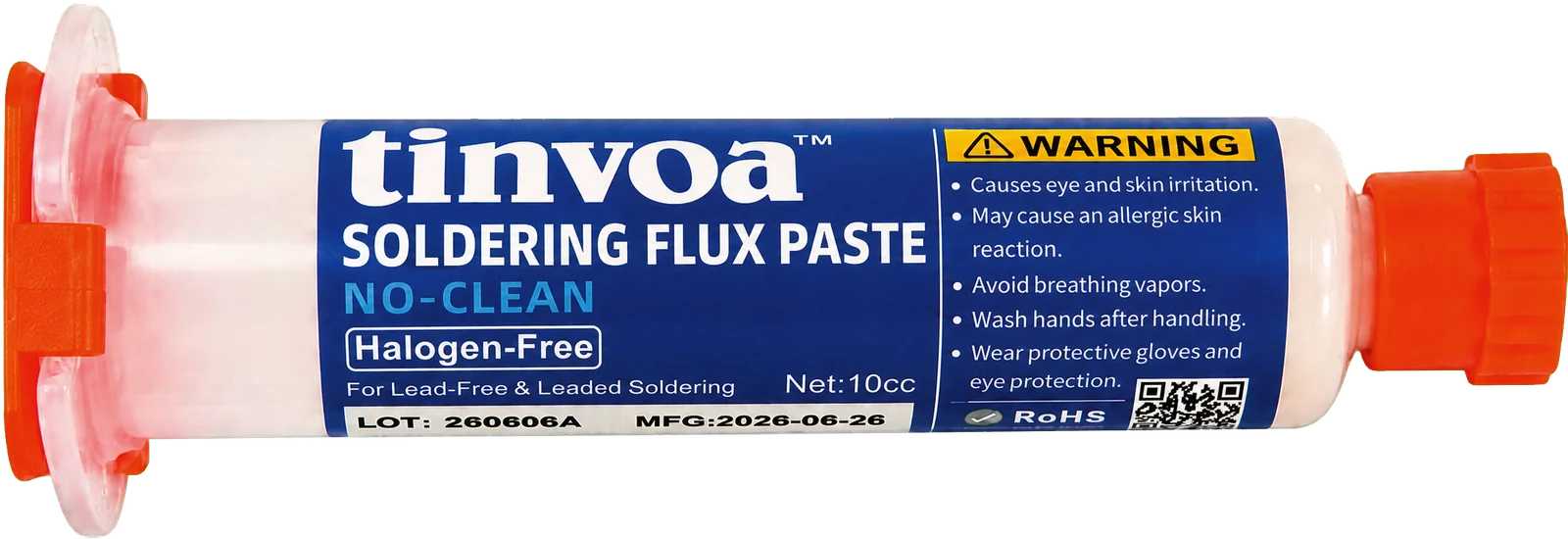
tinvoa No-Clean Soldering Flux — halogen-free no-clean rosin flux, 10cc syringe

No-Clean Soldering Flux

Rosin-based · Halogen-Free · ROL0
10cc syringeHalogen-freeRoom-temp storage12-month shelf lifeUniversal alloy compat.
$9.99/ syringe

Ships from our U.S. warehouse · $4.99 flat shipping · Free on orders of $49.99+ with code FREESHIP at checkout · Shipping & returns

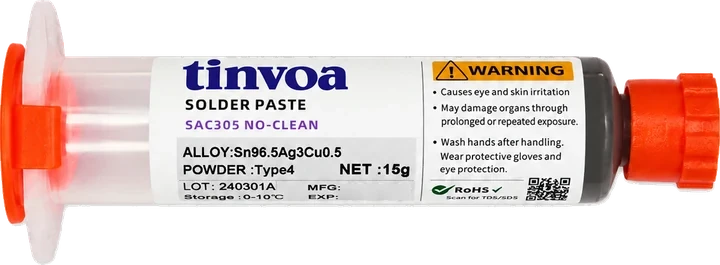
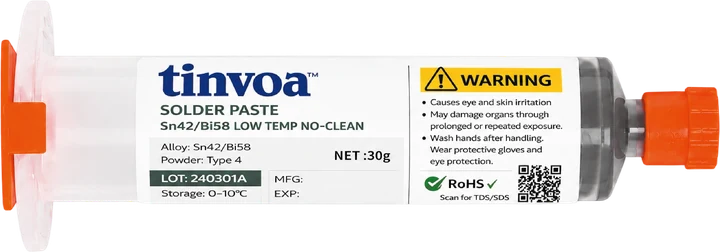
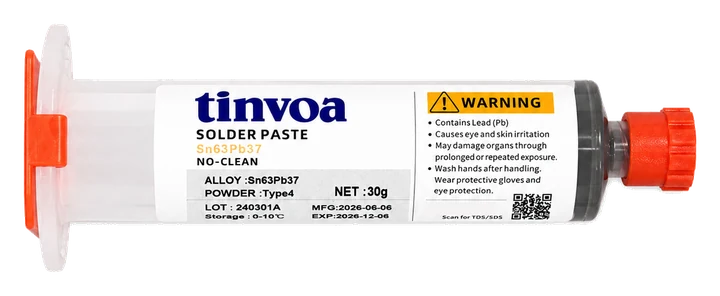
  • Works with SAC305, Sn42/Bi58, Sn63/Pb37 — universal
  • Room-temperature storage — no refrigeration needed
  • Halogen-free · non-corrosive · non-conductive residue
  • 12-month shelf life (2× longer than solder paste)

The general-purpose grade.

This is the flux for everything that does not need to be held — tinning, touch-up, desoldering, cold-joint repair, routine rework. It wets fast and leaves a residue you can walk away from. If a part has to stay put on its own while the board heats, that is a different job and a different grade: see the No-Clean Tacky Flux ($13.99).

Universal Compatibility

One flux, every alloy. Works with SAC family, Sn42/Bi58 low-temp, Sn63/Pb37 leaded — no decision tree.

No Refrigeration

Store at room temperature on the bench. No fridge management, no thaw cycles, no warming wait.

12-Month Shelf Life

Twice as long as solder paste. Bulk-buy without worrying about expiration on a slow bench.

Halogen-Free ROL0

Non-conductive, non-corrosive residue. Safe to leave on the assembly for consumer and industrial work.

What it's made for.

The connective tissue of a solder workflow — pair it with your alloy of choice or use it solo for prep work. Six jobs it does well, none of which depend on the flux gripping a component.

BGA & QFN Rework

Apply to the pads before reflowing a BGA, QFN or LGA that is already seated. Reduces voids and improves wetting. For reballing — where the flux has to hold the ball array in place — use the tacky grade.

Repair & Cold-Joint Fix

Re-wet a dull or cold solder joint without lifting the component. Brief reflow + flux = like-new joint.

Tip Tinning

Recondition oxidized soldering iron tips. Dip the dirty tip into flux + fresh solder for instant tinning.

Wire Pre-Tinning

Coat stranded wire ends with flux + solder before insertion into a connector or PCB. Faster, cleaner joints.

Solder Wick Boost

Apply flux to desoldering wick for faster, cleaner pad clearing. Especially helpful on aged or oxidized joints.

PCB Pad Restoration

Pre-flux corroded or lifted pads before resoldering. Improves solder flow and reduces re-work cycles.

Complete spec sheet.

Per IPC J-STD-004B flux classification.

Typical values are not specifications. Lot-specific data available on request.

Product nameNo-Clean Soldering Flux
Flux TypeNo Clean
Flux ClassificationROL0 (IPC J-STD-004B)
Flux BaseRosin — natural & modified
Activator SystemLow activity, halogen-free organic activators
Halide contentHalide-free — <0.05% by weight in flux solids (IPC-TM-650 2.3.28.1, ion chromatography) — ROL0 per IPC J-STD-004B
Halogen contentHalogen-free — no intentionally added halogens.
Lead ContentLead-Free (RoHS)
AppearanceTranslucent amber paste · clear colorless residue
Solids Content68–72% by weight (typical)
Reflow ProfileDwell 135–160°C (SAC, Sn-Pb) or 100–130°C (Sn42/Bi58) · peak and TAL per your alloy’s TDS
CompatibilitySAC305 · SAC0307 · Sn42/Bi58 · Sn63/Pb37 · all common leaded & lead-free alloys
Substrate CompatibilityCopper · gold · tin · iron · brass · nickel
ResidueNo-clean · clear, colorless, pin-testable · non-corrosive
Package10 cc resealable luer-lock syringe · SKU TFX-RO-10CC
StorageRoom temperature (10–32°C / 50–90°F) · no refrigeration required
Shelf Life12 months unopened · 6 months after opening
ComplianceRoHS-compatible · REACH SVHC declared · Flux ROL0 per IPC J-STD-004B · halide-free
GHS classificationGHS07 · WARNING · H315 · H317 · H319 · H335 Not regulated for transport.

Activation window, peak set by your alloy.

For SAC and tin-lead alloys, dwell in the 135–160°C window. Sn42/Bi58 melts at 138°C, so soak it at 100–130°C instead. The peak is always set by the solder alloy you pair it with.

Flux activation window · SAC / Sn-Pb
135–160 °C
Dwell 1–2 min in this range — the rosin activates, strips oxides, and wets the surface just before the alloy melts. For Sn42/Bi58, soak at 100–130°C instead.
Ramp 1–2 °C/sDwell 1–2 minCool 3–7 °C/s
Peak temperature · set by your alloy
Sn42/Bi58 Low-temp bismuth
~160–170 °C
Sn63/Pb37 Leaded eutectic
~200–225 °C
SAC305 / SAC0307 Lead-free
~235–250 °C

Peaks are typical references — always follow your alloy's TDS and validate on your own thermal-mass test board. Full flux parameters in the TDS below ↓.

GHS hazard communication.

Rosin-based ROL0 no-clean flux paste. Classified under OSHA HazCom 2024 (GHS). Refer to the product SDS for the complete, authoritative classification.

GHS07
Irritant / Sensitizer
Signal word: WARNING

Hazard statements

  • H315 · Causes skin irritation.
  • H317 · May cause an allergic skin reaction (rosin / colophony).
  • H319 · Causes serious eye irritation.
  • H335 · May cause respiratory irritation.

Precautionary statements

  • P261 / P271 · Avoid breathing fumes; use only in a well-ventilated area.
  • P280 · Wear protective gloves and eye protection.
  • P302+P352 · IF ON SKIN: Wash with plenty of water.
  • P305+P351+P338 · IF IN EYES: Rinse cautiously with water. Remove contact lenses, if present and easy to do.
  • P333+P313 / P337+P313 · If skin or eye irritation persists: Get medical advice.
  • P501 · Dispose of contents / container per local regulations.

Keep out of the reach of children. California Proposition 65: rosin (colophony) is not a listed chemical; no warning is required. Safety Data Sheet available on request ↓

Full QA paperwork.

Technical
Technical Data Sheet (TDS)

Full flux specs, reflow profile, compatibility matrix.

Process
Instructions for Use (IFU)

Step-by-step guide for BGA rework, tip tinning, and repair use cases.

Safety
Safety Data Sheet (SDS)

GHS classification, handling, storage, disposal — provided to buyers on request.

Which one do you actually need?

Both are ROL0 — IPC J-STD-004B classifies flux by chemical activity and says nothing about tack, so the two grades share a classification and do different work. One question separates them.

Does the part have to stay put while it heats? Grade
No. Tinning wire, tip conditioning, touch-up, desoldering and wick clean-up, cold-joint repair, pad restoration, or reflowing a part that is already seated and held by its own leads. This one — No-Clean Soldering Flux
$9.99 · available now
Yes. BGA / QFN / LGA reballing, holding components through a reflow ramp, stencil printing, pin transfer, fine-pitch work where flux must not wick across neighbouring pads. No-Clean Tacky Flux →
$13.99 · available now

We are deliberately not selling one flux as if it did both jobs. The higher grade costs more because it carries more solids and a measured tack force — if you do not need that, the grade on this page is the right one and it is cheaper.

The solder alloy behind it.

No-clean flux — questions.

Does this flux work with lead-free and low-temperature solder?

Yes. It is compatible with SAC305, SAC0307, Sn42/Bi58, Sn63/Pb37 and other common leaded and lead-free alloys, on copper, gold, tin, nickel, brass and iron. Dwell at 135–160°C for SAC and tin-lead (100–130°C for Sn42/Bi58) and let the solder alloy set the peak.

Does No-Clean Soldering Flux need refrigeration?

No. Store it at room temperature, 10–32°C (50–90°F). Shelf life is 12 months unopened and 6 months after opening — unlike solder paste, which must be refrigerated.

Do I have to clean the flux off after soldering?

No. It is a no-clean ROL0 rosin flux per IPC J-STD-004B, halide-free, and leaves a clear, colorless, non-corrosive residue. Clean with IPA only if you plan to conformal-coat or want a cosmetic finish.

The flux that goes with
everything.

Ships from our U.S. warehouse — $4.99 flat, free on orders of $49.99+ with code FREESHIP. Bulk and OEM orders ship from our warehouse.