Home/Products/Sn42/Bi58 Low-Temp Solder Paste
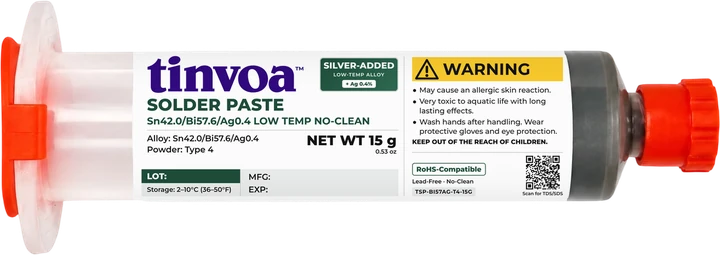
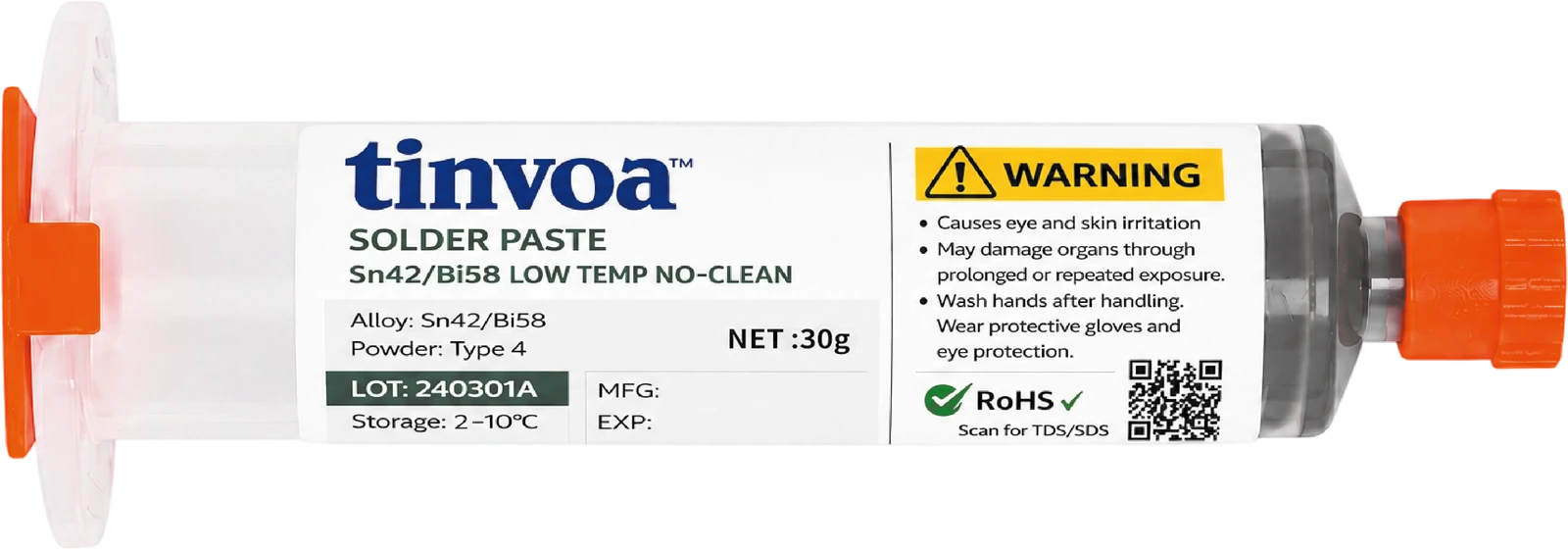
tinvoa Sn42/Bi58 low-temp solder paste — 30g syringe, 138°C bismuth-tin eutectic, Type 4 powder, No-Clean ROL0 flux, RoHS-compatible

Sn42 / Bi58 Low-Temperature Solder Paste

Sn 42% / Bi 58% · Bismuth-Tin Eutectic
138°C eutectic30g / 50gIPC J-STD-005ANo-Clean ROL0Halide-free
Package Size
$14.99/ syringe

Ships from our U.S. warehouse · $4.99 flat shipping · Free on orders of $49.99+ with code FREESHIP at checkout · Shipping & returns

  • True eutectic 138°C melt — no mushy zone
  • RoHS-compatible · REACH SVHC declared · halide-free flux
  • Tested using IPC J-STD-005A methods
  • 6-month shelf life refrigerated (2–10°C)
Engineering data sheet.

Complete specs for Sn42/Bi58 low-temp solder paste. Package details update automatically when you switch size above.

Typical values are not specifications. Lot-specific data available on request.

Alloy CompositionSn 42% / Bi 58% (eutectic)
Melting Point138°C (true eutectic · no mushy zone)
Alloy Density8.56 g/cm³
Flux TypeNo-Clean Rosin · ROL0 (IPC J-STD-004B)
Halide ContentHalide-free — <0.05% by weight in flux solids (IPC-TM-650 2.3.28.1, ion chromatography)
Powder Particle SizeType 4 · 20–38 μm
Metal Content (wt %)≈ 88.5 ± 0.5%
Viscosity200 ± 30 Pa·s (typ.) · Malcom spiral, 10 rpm, 25°C
Tackiness25–45 gf (typ.) · IPC-TM-650 2.4.44, 4 h after print
Slump ResistancePass IPC-TM-650 2.4.35
Package Options30 g / 50 g · resealable luer-lock syringe · SKU TSP-BI58-30G
Shelf Life6 months refrigerated (2–10°C) · ≥ 24 h working time
ComplianceRoHS · REACH SVHC declared · Flux ROL0 per IPC J-STD-004B · Paste per IPC J-STD-005A · Alloy per IPC J-STD-006C
Recommended Stencil4–6 mil (Type 4) · area ratio ≥ 0.66

Cool, controlled, low-temp reflow.

Sn42/Bi58 needs only ~30°C above its 138°C eutectic. Keep peak ≤170°C — excess heat oxidizes bismuth and degrades joint strength.

250°C 200°C 150°C 100°C 50°C 0°C 0s 60s 120s 180s 240s 300s 138°C eutectic melt PREHEAT SOAK REFLOW COOLING Peak 165°C
1 · Preheat
25 → 100°C
Ramp 1–2 °C/s · ~45–60 s
2 · Soak
100 → 130°C
Dwell 60–90 s · activates flux
3 · Reflow / Peak
160–170°C peak
Time above 138°C: 30–60 s
4 · Cooling
170 → 80°C
Controlled cooling ≤ 4 °C/s

For LED strip hand-soldering: use a 1.0 mm hot-air nozzle and bring the joint to 160–170°C (the tool set point usually needs to be higher). Hold for 3–5 s after melt flow is visible. Full guidance in the TDS ↓.

GHS hazard communication.

Low-temp bismuth-tin alloy. Classified under OSHA HazCom 2024 (GHS). Refer to the product SDS for the complete, authoritative classification.

GHS07
Irritant / Sensitizer
GHS09
Environment
Signal word: WARNING

Hazard statements

  • H410 · Very toxic to aquatic life with long lasting effects.
  • H317 · May cause an allergic skin reaction (flux).

Precautionary statements

  • P261 · Avoid breathing dust or fumes.
  • P272 · Contaminated work clothing must not be allowed out of the workplace.
  • P273 · Avoid release to the environment.
  • P280 · Wear protective gloves.
  • P302+P352 · IF ON SKIN: Wash with plenty of water.
  • P333+P313 · If skin irritation or rash occurs: Get medical advice or attention.
  • P362+P364 · Take off contaminated clothing and wash it before reuse.
  • P391 · Collect spillage.
  • P501 · Dispose of contents and container in accordance with applicable local, regional, national and international regulations.

California Proposition 65: no listed chemical is intentionally added to this lead-free formulation. Full classification in the Safety Data Sheet ↓

Full QA paperwork.

Technical
Technical Data Sheet (TDS)

Sn42/Bi58 eutectic alloy specs. Complete physical, chemical, and low-temp reflow data (138 °C melting point).

Process
Instructions for Use (IFU)

Step-by-step low-temp bench guide: warming, stencil printing, reflow at 160–170 °C peak, post-reflow inspection.

Safety
Safety Data Sheet (SDS)

OSHA/GHS-compliant safety information. Handling, storage, first-aid, transport, and disposal protocols.

Compliance
RoHS Declaration

Lead-free verification under EU directive 2011/65/EU and 2015/863.

Compliance
REACH Compliance Letter

SVHC (Substances of Very High Concern) declaration under EU REACH (EC 1907/2006).

Quality
Certificate of Conformance (CoC)

Lot-traceable statement of conformance to this product's specification. Issued per lot with wholesale orders.

Sn42/Bi58 low-temp paste — questions.

Is Sn42/Bi58 solder paste good for LED strips?

Yes — it is the usual choice for LED strips, flex circuits and heat-sensitive parts because it melts at 138°C. In an oven or on a hot plate, peak at 160–170°C with 30–60 s above 138°C. With hot air, use a 1.0 mm nozzle and bring the joint to 160–170°C — the tool's set point usually needs to be higher — then hold for 3–5 s after the paste flows. Keep the peak at or below 170°C; excess heat oxidizes the bismuth.

How strong are Sn42/Bi58 solder joints?

Static strength is good (8,000 psi tensile, typical), but bismuth-tin joints tolerate drop, shock, vibration and heavy thermal cycling less well than SAC joints, and they soften as they approach 138°C. Use a SAC alloy such as SAC305 for parts that run hot or boards that take mechanical abuse.

Can I use Sn42/Bi58 on parts with leaded solder?

No. Lead mixed into tin-bismuth forms a phase that melts near 96°C and weakens the joint. Remove old tin-lead solder completely before reworking with Sn42/Bi58, and don't use it on tin-lead plated leads or pads.

What's the difference between the 30 g and 50 g syringes?

Only the fill. Both are the same Type 4 (20–38 µm) Sn42/Bi58 paste with no-clean ROL0 flux in a resealable luer-lock syringe. Use 20G–22G needles; Type 4 paste suits pitches of about 0.5 mm and above.

Lower temperature.
Lower stress.

Sn42/Bi58 ships from our U.S. warehouse — $4.99 flat, free on orders of $49.99+ with code FREESHIP. Bulk and OEM orders ship with full compliance docs.